CommonWealth College of Excellence (CCE)
Assessment Appeals Procedure
Assessment Appeals
1. A student may wish to appeal against a result notified to him/her by a member of the lecturing staff/ assessor, internal verifier of an academic department, or against a decision of a Teaching and Learning Committee that has been set up to consider the progress of students and the progression of students between levels.
2. Without prejudice to the outcome of the appeal, a student may continue to attend classes and make use of the facilities of the relevant academic department whilst their appeal is being heard. A student should not be disadvantaged in any way or prevented from progressing to the next level of their programme while their appeal is being considered.
3. However, students, who have completed their studies, who have grounds for an appeal, and have submitted a request for a review of an assessment result by a lecturer/ assessor, internal verifier, or Teaching and Learning Committee, will be unable to receive their award until the matter has been fully resolved.
4. These regulations do not cover student complaints. There is a separate procedure for Complaints/Grievances.
Aim of the Procedure
5. The aim of the regulations is to ensure there is a fair and consistent procedure available to students who have grounds for the appeal of an assessment decision, to request a review of that decision.
Grounds for Appeal
6. Appeals against the decision of a lecturer/assessor or a Teaching and Learning Committee will normally only be considered on the following grounds:
a. that a student’s performance was adversely affected by illness or other factors which they were unable or, with valid reason, unwilling to divulge, to their lecturer before undertaking an assessment, or not made known to the Teaching and Learning Committee when it made its decision about the student. The student’s appeal must be accompanied by documentary evidence acceptable to the senior manager in the Academic Department who considers the appeal in the first instance.
b. that evidence is produced that there was a material administrative error, or that the assessment process was not conducted following the programme regulations.
c. that evidence is produced that some other material irregularity has occurred.
7. Appeals will not normally be accepted from third parties.
Aim of the Procedure
8. Appeals that question the academic judgment of a lecturer/assessor or Teaching and Learning Committee will not be considered.
Appeals Procedure
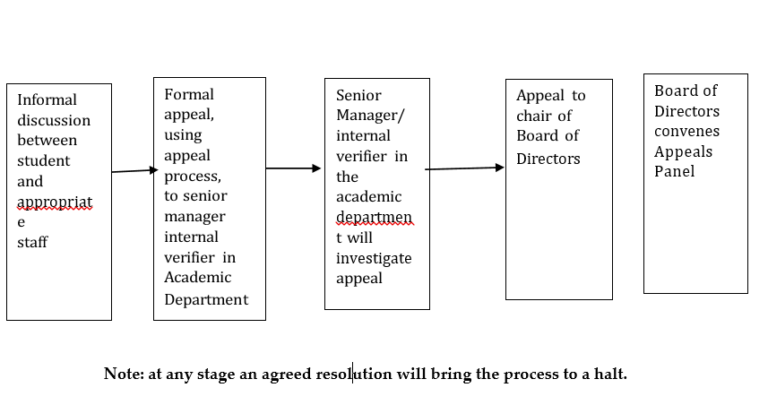
Stage 1 – Informal Procedure
9. A student who is dissatisfied with an assessment result must, in the first instance, discuss the matter with the appropriate staff in the academic department. The relevant lecturer/assessor, Personal Academic Tutor, or programme leader in the academic department where the student is enrolled may be the likely choices for this initial discussion. This should normally be done within ten working days of receiving the result of any assessment.
10. This initial discussion will not alter the student’s right to follow the formal procedure (detailed below) but will represent an early opportunity for ambiguities to be resolved and circumstances taken into account prior to decisions being taken on the assessment.
Stage 2 – Formal Procedure
11. If the matter is not resolved through the informal procedure, a student who wishes to appeal should do so in writing setting out the reasons for the appeal and including documentary evidence. This should be sent to the appropriate senior manager in the Academic department for the programme (students will be provided with the name and contact details of this individual at induction) and must normally be done within 15 working days of having received notification of any assessment result.
12. Upon receipt of the formal appeal, the senior manager in the Academic department will acknowledge the appeal immediately and investigate the appeal normally within ten working days of receipt of the appeal. The investigation could involve interviews with the lecturer/assessor, the internal moderator, the programme leader, and the investigation, the decision of the senior manager in the Academic Department will be confirmed in writing to the student within five working days of the investigation being concluded, together with information on how the appeal has been investigated. The result of the appeal will also be submitted to the relevant staff.
13. If the student is dissatisfied with the decision communicated in Section 12 above they may appeal directly to the Board of
14. If an appeal is referred to the Board of Directors, the Board of Directors will appoint an Appeal Panel consisting of a Chairman and two other responsible members of staff who have not been previously associated with
Stage 3 – Appeals Panel
15. Should the Chairman of Appeal Panel deem the grounds for appeal to be sufficient, he shall convene a meeting of the Panel.
16. Membership of the appeals panel will be approved by the Board of Directors at the start of each academic year. Members of the appeals panel will normally hold tenure for two years.
17. The student will be given written notice of the date and place of the hearing and their rights under this procedure at least ten working days before the hearing. The student must acknowledge receipt of this notification in writing before the hearing will take place.
18. Members of the appeals panel must receive the following documentation at least five working days before the date of the hearing:
a. the student’s appeal, together with supporting documentary evidence
b. the results of the initial investigation carried out by the senior manager in the Academic department, if appropriate.
c. any comments received from the relevant Assessor/Internal verifier/Academic head or Teaching and Learning Committee on the unit or programme assessment requirements
e. the results of all the students taking the particular assessment.
19. Evidence submitted on the day of the hearing will not normally be considered.
20. The chair will inform the student in writing of the outcome of the hearing no later than five working days after the hearing has taken place.
21. The chair of the appeals panel will be responsible for ensuring that the action recommended by the panel is satisfactorily implemented.
Rights and Position of Students
22. The student shall receive in advance of a hearing, all papers circulated to members of the appeals panel, except any documents deemed by the chair to be confidential to the appeals panel.
23. The appeals procedure shall be sent to the student with the notice of a hearing.
24. The student and any other person(s) cited in the appeal, each accompanied if so desired by a friend, has the right to appear before and be heard by the appeals panel. Under this procedure the definition of ‘friend’ does not include members of the legal profession engaged to act in their professional capacity.
25. While the appeal remains unresolved, the student shall have the right to proceed to the next part or stage of the programme, or to recommence the part or stage of the programme on which they were last enrolled as appropriate to the particular case. A student should also not be disadvantaged in any way or prevented from progressing to the next level of their programme.
26. However, students who have completed their studies, who have grounds for an appeal and have submitted a request for a review of an assessment result by a lecturer/assessor/Internal verifier or Teaching and Learning Committee, will be unable to graduate until the matter has been fully resolved.
27. Students’ privacy and confidentiality will be respected, wherever possible. However, unless specifically stated otherwise, it will be assumed that students have given permission to disclose as necessary any information provided. If students wish any matter to remain confidential they must so state when lodging their formal appeal. In such cases, it may not be possible to fully consider the appeal.
Rights of Lecturers and Teaching and Learning Committee
28. The chair of the Teaching and Learning Committee concerned with each case considered by the appeals panel shall be invited, prior to the meeting, to submit to the appeals panel comments relevant to the case under discussion.
29. A lecturer/assessor/internal verifier whose decision is being appealed against and / or the Teaching and Learning Committee involved in making a decision about a student that has been appealed against, shall have the right to be represented at the hearing of an appeals panel. It shall be the duty of the chair of the board to determine who shall represent the Teaching and Learning Committee at such hearings.
Procedure at a Hearing
30. Once the appeals panel has determined an outcome, the student, and any other relevant parties, should be provided with a ‘completion of procedures letter’. The letter will include a clear written statement confirming that the internal procedures have reached completion, the outcome that has been reached, and the reasons behind the outcome.
31. The procedure to be followed at a hearing shall be determined by the chair in consultation with other members of the appeals panel at the commencement of the hearing. According to the circumstances, the parties to the appeal may be seen separately (in whatever order is deemed appropriate) or together. The appeals panel will normally ask the student, the relevant staff member(s) involved, and all witnesses to leave before considering the evidence and reaching a decision.
32. The letter should also advise the student of any relevant external procedures to which they may have recourse if they remain dissatisfied with the final outcome or response to their appeal. Further information, such as how and when any remedy will be implemented, might also be included.
Powers and Terms of Reference of an Appeals Panel
33. An appeals panel, acting on behalf of Board of Directors, shall consider and determine requests for a review of a decision of a senior manager of Academic department/Internal verifier and/or Teaching and Learning Committee. An appeals panel shall not have powers to deal with appeals arising from disciplinary matters or from allegations of cheating or plagiarism.
34. An appeals panel shall have the power to require the attendance of any member of staff providing a reasonable period of notice is given for such attendance, and shall be given access to any records and documents which it regards as crucial to its operation.
35. In cases of withdrawal, the appeals panel shall have the authority to revoke or confirm the decision to withdraw the student from a programme.
36. Such a revocation shall entitle the student either:
a. to proceed on the programme, or
b. to repeat the failed part of the programme at the earliest opportunity, whichever the appeals panel judges to be in the best interest of the student. These provisions are subject to the continued availability of the programme in a suitable form.
37. In cases of appeals against an assessment decision, if the appeals panel decides for the student, the lecturer/assessor/internal verifier concerned will be notified and must reconsider their decision. The lecturer/assessor/internal verifier, in undertaking such reconsideration, shall have regard to the report of the appeals panel, and to the recommendations contained therein.
38. In appeals against withdrawal where the assessment decision leading to the withdrawal also becomes subject to the appeal, the appeals panel shall decide separately on the two appeals.
39. Whenever there is no unanimous agreement, decisions of the appeals panel shall be by majority vote.
40. If, after reconsideration, in cases of appeals against an assessment decision, the lecturer/assessor confirms their original decision, the appeals panel may be reconvened at the request of the student or the chair of the appeals panel to consider further the position of the student. In such an event the appeals panel shall meet in private and, if it is the panel’s opinion that due and proper account has not been taken of its decision and / or recommendations, it shall have the power to annul the whole assessment, or any part of it, in relation to the student concerned.
41. Any such amendment of an assessment will give the student the right to being assessed again in the whole assessment, or any part thereof. This further assessment shall be conducted as though the cancelled assessment had not taken place.
42. The appeals panel shall make an annual report and have the right to make recommendations and observations to Board of Directors concerning any matters of detail or principle arising from a hearing.
Reporting Procedure and Confidentiality of Hearing
43. The proceedings of appeals hearings shall be confidential to the parties involved. A report of the decision shall be communicated to Board of Directors, together with any specific recommendations or observations that the appeals panel decides to make to its parent body.
44. A report of the hearing shall be made available to the members of the appeals panel, the student concerned, and to all relevant parties involved, including the Academic head/assessor/internal verifier, if appropriate, who may in turn circulate it to Teaching and Learning Committee if decisions taken about a student are subject to reconsideration. The report shall be confidential to those persons to whom it is circulated.
Stage 4 – Board of Directors
45. Board of Directors shall consider the recommendations of the appeals panel and take appropriate action.
46. If the report recommends annulment of the decision of a lecturer/ assessor/internal verifier/Academic head or of Teaching and Learning Committee, the Board of Directors must take appropriate action, including where necessary replacement of Academic head/ lecturer/assessor/internal verifier or reconstitute or Teaching and Learning Committee to receive new recommendations concerning the assessment of the student(s).
47. The Board of Directors will receive an annual report from the appeals panel and monitor and review the effectiveness of the appeals process regularly, enhancing the Appeals procedure in line with developments in good practice.
48. If the report recommends the appeal be dismissed, the student may have a further right of appeal through the appropriate awarding body appeals procedure.
49. Candidate can contact awarding body if dissatisfied with the centre’s decision. If any appeals are lodged with the centre, the EV will review the details during the External Verification visit.
50 .Appeal Procedure relating to Awarding Bodies.
If the appeal procedure relates to any awarding body, UK Business College will follow the procedure of the Awarding body as prescribed in their Rules and Regulations. The student will find appeal Procedure of the awarding bodies on their respective websites. If there is any problem the college will help the student to locate the website and to find the right contact.
Timescale of Assessment Appeals Procedure (SQA and other Awarding Bodies)
Stage | Timescale | Appeals procedure | Outcome |
1 | Within ten working days of receiving assessment result | Informal procedure Student tries to resolve matter by informal discussion with appropriate staff/ assessor. Appeal still unresolved. | Possible resolution |
2 | Within 15 working days of receiving an assessment result | Formal procedure At this stage, the student must supply reasons for appeal to the senior manager/ internal verifier in the Academic department with evidence where appropriate, who will immediately acknowledge receipt of appeal. | |
Within ten working days of receipt of an appeal | Wherever possible, a full investigation of the appeal will be conducted within 10 working days of receipt of an appeal. | ||
Five working days of conclusion of investigation | The decision of the senior manager/ internal verifier in the Academic department will be confirmed in writing to the student within five working days of the investigation being concluded, together with information on how the appeal has been investigated. The result will also be submitted to the relevant staff. | Possible resolution | |
If an appeal is made to the Board of Directors, it will appoint an Appeal panel whose chair shall determine if the grounds for appeal are sufficient. The decision of the chair is final in this respect. |
Possible resolution | ||
3 |
Ten working days prior to hearing |
Appeals Panel If the grounds for appeal are deemed sufficient, the chair of Board of Directors will convene the appeals panel. The student will be given written notice of the date and place of the hearing and their rights, and must acknowledge receipt of the notification in writing before the hearing will take place. | |
Within five working days of the hearing | The chair will inform the student in writing of the outcome of the hearing no later than five working days after the hearing has taken place. | Possible Resolution | |
4 | The Board Of Directors will consider the recommendations of the appeals panel and take appropriate action. The student may have a further right of appeal through the appropriate validating body appeals procedure. |
Diagrammatic Representation of Assessment Appeals Procedure