
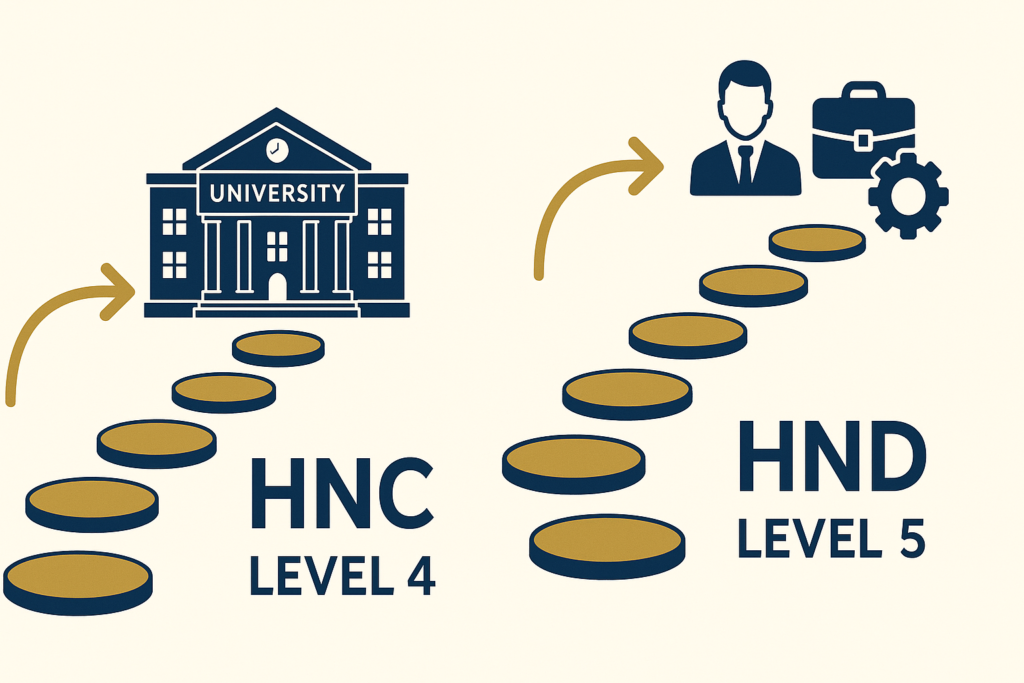
Difference between HNC and HND
If you are researching further education in the UK and have come across the terms HNC and HND, you are not alone in feeling confused. These qualifications are respected and practical routes into higher education and professional development, yet many students are unsure exactly what separates them.
At Commonwealth College of Excellence (CCE), students can study HNC and HND routes in areas such as Business, Computing, and Leadership and Management. This guide explains what HNCs and HNDs mean, how they differ, how long they take, what you can study, and where each qualification may lead.
Difference Between HNC and HND: What Does HNC Mean?
HNC stands for Higher National Certificate. It is a Level 4 qualification on the Regulated Qualifications Framework (RQF) in England, which means it sits at the same level as the first year of a full university degree. The HNC is designed to give students a solid foundation of knowledge and practical skills in their chosen subject area.
At CCE, our Pearson BTEC Level 4 HNC programmes in Business and Computing are built around a carefully structured set of core units that introduce students to the key concepts, skills, and professional practices of their chosen field. For example, the HNC in Business covers units such as Business and the Business Environment, Marketing Processes and Planning, Human Resource Management, Leadership and Management, and Accounting Principles. The HNC in Computing, meanwhile, covers Programming, Networking, Professional Practice, Database Design and Development, Security, and Planning a Computing Project, among others.
An HNC typically takes one year to complete on a full-time basis, though many students choose to study part-time alongside employment, which can extend the duration. This flexibility is one of the great strengths of the HNC qualification — it is designed with working professionals and career-changers in mind, not just school leavers.
For students comparing the difference between HNC and HND qualifications, the HNC is usually the starting point because it introduces the foundation knowledge and practical skills of the subject.
Students who want to understand how qualification levels work in England can check the official GOV.UK guide to qualification levels.
Difference Between HNC and HND: What Does HND Mean?
HND stands for Higher National Diploma. It is a Level 5 qualification, sitting at the same level as the second year of a full university degree. The HND builds directly on the knowledge and skills gained at Level 4, adding greater depth, complexity, and specialisation.
At CCE, our Pearson BTEC Level 5 HND programmes take students deeper into their subject. In Business, Level 5 students explore Organisational Behaviour, Business Strategy, Employee Relations, Understanding and Leading Change, and Planning for Growth. In Computing, the HND adds units such as Emerging Technologies, Systems Integration, Machine Learning, Cloud Computing, Big Data Analytics and Visualisation, and Applied Cryptography in the Cloud.
The HND is typically a two-year full-time qualification, or longer when studied part-time. Students who already hold an HNC can often progress directly into Level 5 study, meaning the HNC and HND work as a natural, connected progression pathway.
The main difference between HNC and HND study is that the HND takes learning further, with greater depth, more advanced units and stronger progression potential.
Pearson explains that BTEC Higher Nationals provide specialist learning at Levels 4 and 5 and can support progression into employment and further study.
Key Differences Between HNC and HND Qualifications
The most important difference between HNC and HND qualifications is the level of study.
An HNC is normally a Level 4 qualification. It is often compared to the first year of a university degree.
An HND is normally a Level 5 qualification. It is often compared to the second year of a university degree.
However, the difference is not only about level. Students should also consider depth, duration, specialism and progression.
1. Level of Study
The HNC is Level 4, while the HND is Level 5. This means the HND is studied at a higher academic level and usually involves more advanced work.
2. Duration
An HNC usually takes one year full-time. An HND usually takes two years full-time, or one additional year after completing the HNC.
3. Depth of Learning
The HNC gives students a strong foundation. The HND builds on that foundation and goes deeper into the subject.
4. Specialist Pathways
An HND often includes more specialist units. For example, Computing students may explore areas such as software engineering, cyber security, data analytics, network engineering or applications development.
5. Research and Project Work
HND programmes often include larger research or project units. These help students build independent study, analysis and problem-solving skills.
6. Career Development
Both qualifications can support career development. However, the HND may be more suitable for students who want deeper knowledge or more advanced progression options.
7. Degree Progression
An HND may support progression to a relevant degree top-up or final-year route. Entry depends on the university, course, grades achieved and admissions requirements.
HNC vs HND Comparison Table
| Feature | HNC | HND |
|---|---|---|
| Full name | Higher National Certificate | Higher National Diploma |
| Level | Level 4 | Level 5 |
| Typical full-time duration | 1 year | 2 years |
| University comparison | Similar level to year 1 of a degree | Similar level to year 2 of a degree |
| Study style | Practical and applied | Practical, applied and more advanced |
| Progression | May lead to HND or further study | May lead to degree top-up or final-year entry |
| Best for | Foundation knowledge | Deeper specialist study |
Which Qualification Is Right for You?
Choosing between an HNC and an HND depends on your goals, current qualifications, available time and future plans.
The HNC may be right for you if:
- you are new to higher education
- you want a shorter qualification
- you want to build confidence first
- you want a practical introduction to the subject
- you may want to progress to the HND later
The HND may be right for you if:
- you want a deeper qualification
- you are ready for Level 5 study
- you want more specialist units
- you may want to progress to a degree top-up
- you want a broader platform for future development
For many students, the difference between HNC and HND study comes down to how far they want to progress at this stage. The HNC can be a strong first step, while the HND takes the journey further.
Progression After an HNC or HND
Both HNC and HND qualifications can support progression. However, the route may differ depending on the level you complete.
Students who complete an HNC may progress to:
- an HND
- further higher education study
- employment in a relevant field
- professional development
Students who complete an HND may progress to:
- a relevant degree top-up
- final-year entry at some universities
- employment in a related area
- further professional qualifications
Progression is not automatic. It depends on the receiving university, employer, course match, grades achieved and specific entry requirements.
For students comparing the difference between HNC and HND progression, the HND may offer a more direct route to degree top-up study because it is a Level 5 qualification.
For wider guidance on university applications, students can visit UCAS, the UK’s university and college admissions service.
When Should You Choose an HNC?
An HNC may be suitable if you want a shorter and more flexible route into higher education. It can help you build foundation knowledge before deciding whether to continue to a higher level.
It may be especially useful for:
- school leavers
- adult learners
- career changers
- working professionals
- students returning to education
- learners who want to build confidence first
The HNC is a complete qualification in its own right. However, many students also use it as a stepping stone to the HND.
When Should You Choose an HND?
An HND may be suitable if you want a deeper qualification with more advanced study. It can help you build stronger subject knowledge and may support future progression to degree-level study.
It may be especially useful for students who:
- want to complete Level 5 study
- are interested in specialist pathways
- may want to progress to a degree top-up
- want a broader qualification than the HNC
- are ready for more advanced assignments and projects
This is another important difference between HNC and HND study: the HND usually gives students more time to specialise and develop advanced skills.
Why Choose Commonwealth College of Excellence?
At Commonwealth College of Excellence, students can explore HNC and HND programmes designed to support practical learning and progression-focused study.
CCE offers routes in areas such as:
- Business
- Computing
- Leadership and Management
Students can explore available courses at Commonwealth College of Excellence and choose the route that best matches their goals.
Learners who want academic or personal guidance can also read more about student support at Commonwealth College of Excellence before starting their course.
Before applying, students should review the admissions process at Commonwealth College of Excellence so they understand the entry requirements, documents and next steps.
Conclusion: Understanding the Difference Between HNC and HND
The difference between HNC and HND qualifications is mainly level, duration and depth. The HNC is usually a Level 4 qualification that gives students a strong foundation. The HND is usually a Level 5 qualification that takes learning further and may support progression to degree-level study.
Both qualifications can be valuable. The right choice depends on your goals, current qualifications, preferred study route and future plans.
At Commonwealth College of Excellence, students can explore HNC and HND routes in Business, Computing, and Leadership and Management. Our admissions team can help you understand which route may be suitable for your next step.